

Enterprise SaaS companies are starting 2026 in an environment where visibility defines opportunity. Organic search is no longer something that quietly supports paid demand generation. It has become a critical growth engine that determines who gets discovered first, who shapes the early buying narrative, and who earns trust before the first conversion even happens. As competition intensifies and sales influence shifts later into the funnel, the companies that already treat search as a core business function are accelerating ahead of those relying heavily on paid channels.
The financial outcomes behind strong enterprise SaaS SEO performance are now clear. Consistent investment delivers a return approaching 702% with payback in roughly seven months, while helping reduce customer acquisition costs by 38% over a 3 month period. Today, 53% of website visits among leading SaaS brands originate from organic search, making it the single strongest source of pipeline. Yet, more and more SaaS organizations are becoming more dependent on paid advertising because their organic momentum has slowed. The result is a widening gap between brands that own discovery and those still renting attention from ad platforms.
A Market Reshaped by AI and Zero-Click Search
What has fundamentally changed is not the importance of search, but how buyers search.
AI-generated results are replacing traditional blue links, and more users are getting their answers directly on the results page. Zero-click searches now account for more than half of activity on both desktop and mobile, and forecasts suggest that by 2026, nearly two-thirds of all searches may end without a click. Voice interactions reinforce this shift by delivering a single answer instead of directing users to browse.
That’s not all. Discovery is also expanding beyond Google. Buyers researching enterprise solutions now turn to AI-native platforms like ChatGPT Search, Perplexity, and Gemini. Each uses different models to determine which brands appear credible and citation-worthy.
What does that mean for you? Google is no longer the assurance of visibility it once was.
A modern SEO strategy must account for multiple systems that prioritize structured, authoritative, and machine-readable content.
Why 2026 Is a Line in the Sand for Leaders
SEO influence compounds over time, meaning that leaders who act early gain advantages that are increasingly difficult to reverse.
With most enterprise SEO programs reaching full revenue impact within six to twelve months, those waiting until 2027 to invest will already be behind. The experimentation phase of AI-driven SEO has passed, which also means:
- Tools, frameworks, and measurement models are mature
- Revenue attribution is more rigorous
- Competitors have proof points
Organizations delaying investment now are not simply postponing growth – they are choosing to operate at a permanent competitive deficit against companies that have already captured topical authority and AI-driven credibility.
Why Enterprise SEO Is More Complex and More Consequential
Scaling SEO inside an enterprise is uniquely challenging. Large SaaS buying cycles involve six to ten stakeholders, each searching with different needs and vocabulary.
Security leaders want proof of data governance. Engineering teams research integration depth and extensibility. Revenue executives focus on efficiency and total cost of ownership. Procurement validates vendor risk. When all these searches happen across months, SEO must serve multiple paths that eventually converge into one buying decision.
Then come websites. They are equally complex.
Enterprise SaaS organizations manage extensive product ecosystems, industry-specific messaging, partner integrations, documentation libraries, and regional variations (sometimes in multiple languages!).
Without strong technical governance, fragmentation can rapidly undermine visibility. Plus, navigating cross-functional approvals for every page isn’t easy. It creates operational friction that must be accounted for in strategy and planning.
2026 Enterprise SaaS SEO Trends That Will Shape Market Winners
AI-First Search Visibility and Zero-Click Experience Design
In 2026, SEO success increasingly depends on earning placement where clicks may never occur. Being cited inside an AI overview or referenced by generative systems can still influence brand perception and future search behavior.
To do this consistently, content must be structured around clarity:
- Clean heading hierarchies
- Direct explanations
- Well-defined terminology
- Page layouts that allow AI models to extract meaning
Freshness signals also matter more than ever, especially in markets where capabilities evolve rapidly.
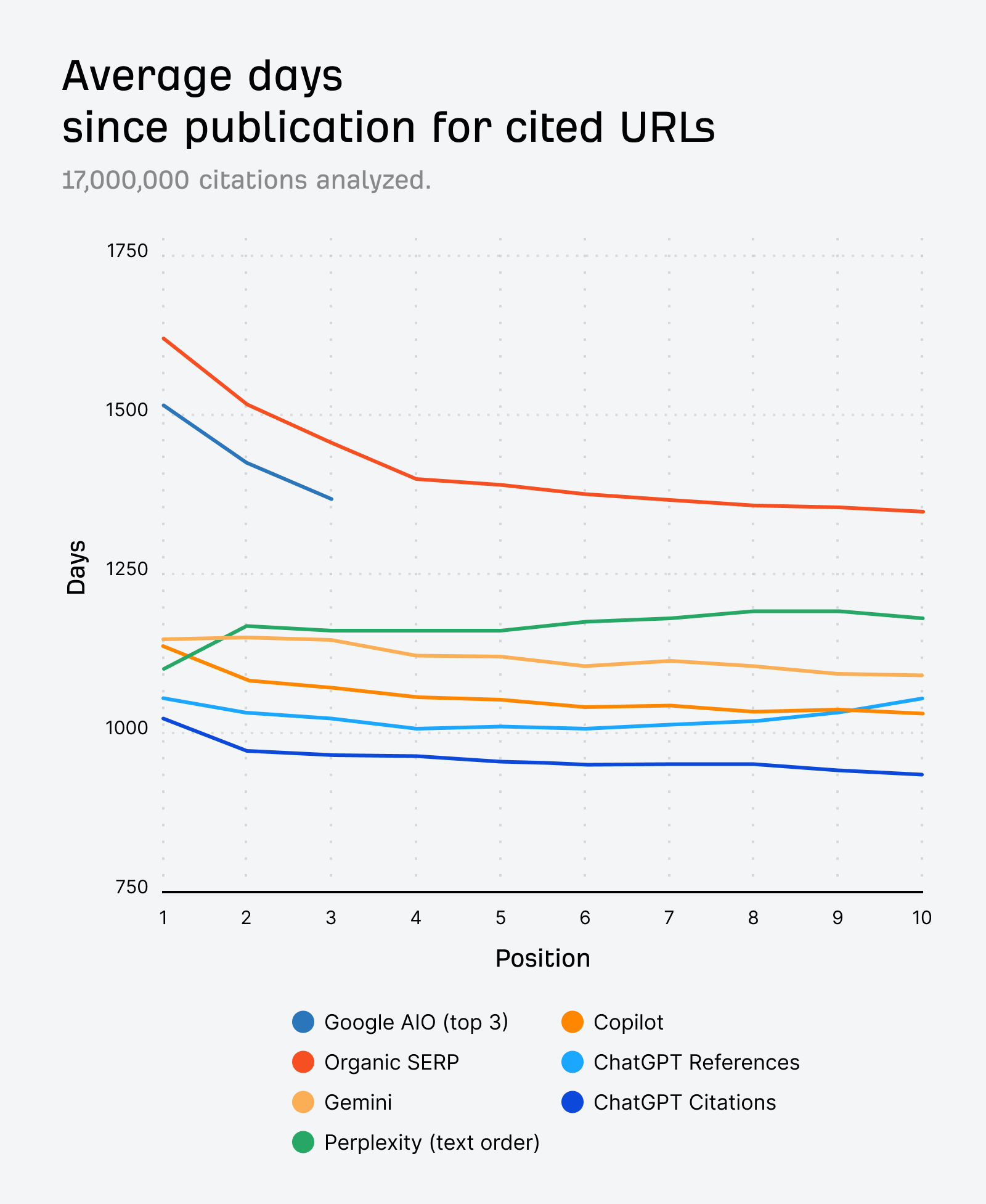
Source: https://ahrefs.com/blog/do-ai-assistants-prefer-to-cite-fresh-content/
When vendors update content in alignment with actual product changes, they remain the source that search and AI systems trust.
Keyword Intelligence Aligned to Real Buying Intent
The most advanced SEO enterprise programs build a strategy around how decisions are made, not how keywords rank.
Buyers search differently depending on role and stage. Early research focuses on business problems, mid-funnel queries generally compare solution approaches, and late-stage searches evaluate specific vendors. A modern enterprise keyword strategy maps topics to personas along this progression so that every stakeholder finds content that speaks directly to their priorities.
This kind of alignment creates cleaner movement from discovery to evaluation to revenue influence, ensuring SEO drives commercially relevant outcomes rather than vanity traffic.
Technical SEO Built for Scale, Speed, and Governance
Website performance is no longer merely a ranking factor. It directly impacts conversion, credibility, and retention. Large SaaS websites must maintain consistent URL logic, resolve duplication risks, and ensure that JavaScript-heavy product experiences remain crawlable.
Technical governance systems are essential, including:
- Pre-launch SEO checks integrated into product workflows
- Quarterly site health audits tied to roadmap execution
- Structured ownership for resolving issues that affect indexability and Core Web Vitals performance
When the technical layer is strong, every content initiative produces strong returns.
Topical Authority as a Competitive Differentiator
Enterprise SaaS decision-makers want proof that a vendor understands the category better than anyone else. Search and AI models reward that depth of knowledge. Instead of distributing content thinly across many topics, leaders are consolidating expertise by establishing pillar themes and linking supporting content underneath them.
It creates both a cleaner educational path for buyers and a stronger credibility signal for AI systems looking for authoritative sources.
Over time, organizations with well-structured topical ecosystems benefit from increased citations, higher conversion on gated assets, and stronger analyst recognition.
Revenue Attribution That Shows What SEO Really Delivers
Enterprise SEO is finally able to take its rightful position as a revenue engine because measurement has evolved. Multi-touch attribution models demonstrate how early-stage discovery influences opportunity creation later in the funnel.
CRM-connected reporting highlights the specific assets driving stage progressions and pipeline acceleration. Executives can now see which organic touchpoints contribute to efficiency, reducing reliance on spend-heavy channels and making growth more resilient when paid costs rise.
Key 2026 Focus Areas for Enterprise SaaS Teams
| Strategic Focus | What It Solves | Measurable Outcome |
| AI-first search discoverability | Declining click-through visibility | Maintained presence in zero-click interactions |
| Intent-aligned keyword strategy | Fragmented buyer journeys | Higher quality pipeline from organic search |
| Technical governance | Complexity and performance risk | Stable rankings and stronger UX |
| Topical authority ecosystems | Lack of perceived expertise | Higher trust and AI citations |
| Revenue-linked attribution | Budget resistance | Long-term investment support |
Final Thought
Enterprise SaaS growth now begins long before sales conversations begin. The vendors that appear early in the research purposes and appear credible not only to humans but also to AI systems take care of the buying narrative. They become the default choice in the market’s mind. That advantage compounds quarter after quarter, making it increasingly difficult for slower competitors to recover.
SEO success in 2026 is about market presence, buyer confidence, and defensive strength in a discovery landscape where brand authority defines opportunity.
2026 is the moment for SaaS leaders to make SEO a true growth opportunity and own the discovery journey before someone else does.